Saturday, December 19, 2020

The Simplicity Project

It seemed like a good idea at the time.  Until...

It began as a project launched by the selection of my 2021  "Word Of The Year."  Simplicity.  I got a jump start early in December purging the kitchen of utensils, dishes, cups collected from a multitude of "swag bags" given out at conventions and fairs and advertising campaigns.  Gadgets I either haven't used in awhile, can't figure out how to use, or which appeared capable of causing great bodily harm if used.  That was pretty easy.  It gave me the confidence needed to move on to bigger game.  My clothes closet.  Which proved even easier.  I don't hold any particular sentimentality when it comes to my "wardrobe."  I can part with those things with relative ease (except, of course, for my absolute favorite  Abercrombie & Fitch jeans, size 4, that are 40 years old.  Do I even need to add that they no longer fit?  Hope does spring eternal, though.  I'm keeping them because you...just... never...know).  Buoyed by that success, I was ready to move on.

But here is where I hit a wall.  My books. 

I have no idea how many books I have.  I still have the very first book I ever owned:  The Tall Book Of Make-Believe, given to me by my Mom when I was 3 or 4.  It is by now, of course, a well-worn mess.  In other words, it's beautiful.  Believing the only way to begin is to begin, I started counting spines beginning with the shelves downstairs and expecting at least several hundred.  I stopped when I reached 700, not including cookbooks.  The thought of continuing the count upstairs was too exhausting to contemplate, so I did a "guesstimate."  I'm questioning the efficacy of my "Word Of The Year,"  But I've already entered it in my new planner.  In ink.  (Although, clever me, written on a post-it note, so its fungible). 

Should I decide to take the advice of Marie Kondo, I would pull out all the books I own (even the ones from my car, because one never knows when one might get caught in a traffic jam) and pile them onto the floor.  If I understand the method correctly, I am then to hold each book and ask myself  - or do I ask the book?  I'm fuzzy on that part of the process - whether it gives me joy.  Joy goes into one pile; No Joy goes into another.  The No Joy pile is carted away and only Joy remains.  The only problem with that theory is, it doesn't work.  If I picked up each book I own and held it (I can't even imagine how many days of my life this practice would require), the routine would end with me opening each book and paging through it.  I'd get carried away reading something, the light would start to fade in the room as the sun made it's journey West, and I would be sitting in the middle of a hard floor piled with over a thousand books...all of which now needed to be put away, and not feeling any joy whatsoever. Feeling stiff.  Feeling a difficulty getting up.  Just brushing by that picture in thought is making me feel anxious  - and pretty damn joyless.

I did try to purge books last year.  I managed to select two books to take to the Little Free Library on the back of the island.  I chose Radium Girls by Kate Moore, and The Ghost Road by Pat Barker.  I was able to part with Radium Girls for several reasons, not the least of which is I pretty much hated it.  Not so much for the writing (although I had issues with it), but because of the way I "felt" when I read it.  The subject matter is beyond gruesome, made even more painful to read because it tells a true story. Adding to the grim subject matter was my own physical discomfort when reading it.  I was on a flight in a small plane.  Although I was sitting in the first row for "added leg room," it was decidedly uncomfortable.  The cabin air was heavy and apparently had only two temperature settings:  Too Hot and Too Cold...plus, I faced the bathroom...which was only several feet away.  I won't elaborate; use your imagination.  The rows were so tight behind me I could not in good conscience put my seat back.  I could have used a pillow (and not for my head).  The book just added to the entire package of misery.  Thereafter, every time I got a glimpse of it on the shelf, I relived the experience.  And so, to be honest, I was happy to unload it.  I had a last minute change of heart regarding The Ghost Road, though.  It came back home with me.  ONE book.  I purged one book.  Obviously, "The Simplicity Project" has hit a bit of a blip.  But now that the kitchen has more room, I can always store some books in the pantry...or in my closet.  So it's not a total fail.  


Thursday, May 19, 2016

The Demon-Haunted World

Chances are when you hear the words “billions and billions” spoken, you do not hear them in your own voice, but in the voice of the late Carl Sagan – that is if you’ve ever seen Cosmos, the fascinating 13-part science series he wrote and narrated. (Although he really never said that in Cosmos.  We only think he did because Johnny Carson would often do a funny bit imitating Sagan and he would say “billions and billions”).   And that is the voice I heard as I settled into The Demon-Haunted World:  Science As A Candle In The Dark, published in 1996, the year of his death.  The book is so Saganesque that nearly two decades later, that slightly nasal, roundish voice is what I heard on every page. 

Sagan takes on all manner of magical thinking, without reservation:  pseudoscience, superstition, zealotry, witchcraft and “biblical literalists.”  UFO encounters, miraculous healings, beatific visions, claims of being teleported to alien spaceships all have prosaic explanations, he believed, once subjected to common sense analysis.  “There are wonders enough out there without our inventing them.”  Living in what is considered the most haunted city in America, I must take umbrage with his scoffing at the existence of ghosts, however, for they most certainly do exist.  Savannah has oodles of them; we’ve built a burgeoning tourist industry on them.  One stormy night I’ll tell you about my own experiences.  But, for now we will only speak about this incredibly enthralling book.

In short, Carl Sagan was the nonpareil scientist who believed only that which can stand up to scientific proof.  One might come away with the conviction that Sagan was an atheist; however, he denied this.  Sagan explained faith as belief in the absence of evidence; he would simply withhold belief until there was evidence.  If one could actually prove an infinitely old universe, he argued, then one might be able to disprove the existence of a God Creator.  An atheist essentially declares there is no God – a theory which Sagan believed was impossible to prove - at least in his lifetime with the tools currently at our disposal.  He fit more comfortably into the cloak of an agnostic.  I believe if God could be proven there would be no need for faith; and, science requires that we skeptically interrogate the universe.  But I find no discordant notes between the two, probably because I’d rather not.

As dismissive as he was regarding the validity of “miracles” and a life after death, he was nevertheless very careful to acknowledge the positivity religion can bring to the lives of humans: history, ethics, compassion, morals, and poetry can, and often do, find their roots in religious belief.  Where he found fault was in what he termed “biblical literalists” who believed in a God who spoke to an unerring stenographer, leaving no room for allegory or metaphor or interpretation.  Sagan did not suffer those whom he considered fools easily.

It is no surprise that Sagan was a great champion of reading and critical thinking, which are delightfully subversive and dangerous in any unjust society.  This was true in the days of American slavery and is true today in cultures that can only thrive if certain segments of the population are kept in the darkness illiteracy breeds.  As he rightly points out, tyrants have always understood that literacy and the free expression of ideas through books and newspapers encourage thought.  Thought begets disobedience and skepticism and, ultimately, power over the tyrant.  “The gears of poverty, ignorance, hopelessness and low self-esteem mesh to create a kind of perpetual failure machine that grinds down dreams from generation to generation.  We all bear the cost of keeping it running.”  Sadly, not much has changed since he wrote those words a generation ago. One only needs to look at reading scores (if students are even tested anymore in our culture of “everyone wins so no feelings are hurt.”). 

Sagan tells the story of a young slave named Frederick Bailey who understood literacy was the path to freedom.  Armed with that understanding, he taught himself to read, fled to New England, and changed his name to Frederick Douglass, after a character in Sir Walter Scott’s The Lady of the Lake.  Douglass went on to become one of the greatest orators in American history.  As Sagan says, “There are many kinds of slavery and many kinds of freedom.  But reading is still the path.”

If it can be said that there is a dichotomy between science and mysticism, Carl Sagan himself was a sort of fascinating dichotomy.  His greatest hero was Thomas Jefferson, which surprised me.   Not that Jefferson doesn’t deserve the accolade (he is a hero of mine as well), but there is a bit of disconnect when in extolling Jefferson’s virtues as a scientist, botanist, astronomer, philosopher, writer, thinker and, of course, chief author of the Declaration of Independence – he fails to point out he was also a slaveholder.  This is what Sagan might call two uneasily cohabiting modes of thought.  It also makes him more human and approachable.


Reading The Demon-Haunted World, though not tome-like, took longer to finish than I expected.  Not because it wasn’t gripping and exceedingly well written; it was both.  But I found myself going off on tangents, putting the book down to find more information on topics he was raising, like Franz Mesmer, or Project Ozma, or Edward Teller and thermonuclear war (which is far more frightening than the prospect of being teleported to a space ship or running into a ghost at the top of the attic stair, let me tell you).  But I was also fascinated by Carl Sagan, the person, and in his private life.  I can see why people either loved or despised him.  (Apparently, he could be something of a pill.  His second wife understandably finds it hard to forgive him after he informed her that he and their mutual friend, Ann Druyan, discovered they were hopelessly in love and were going to get married.)  Sagan seems to have had an insatiable need for attention – both personally and in his work.  But the man could think, and write, and inspire.  This book is wise, elegant, lucid, unyielding and as far from dull as science can get.  We have lost much.

Wednesday, January 13, 2016

...And The Cow Jumped Over The Moon

The room was quiet and bathed in mid-morning light.  I had been reading for an hour but it was time to accomplish the work of the day.  I closed my book and looked over to where my mother sat at her usual place on the couch, wrapped as always in a blanket for she is perpetually cold – or so she says.   Her eyes were closed; she was asleep.  I noticed her hands resting on her chest.  I began to cry.   I began to cry because something hit me sharp and hard.  It hurt.  To those hands, which were always so strong and yet so gentle, I owe so much.   Those were the cool hands I felt on my hot brow when I was sick; they were the ones that sewed my favorite childhood dress.  She let me pick the fabric and I chose a soft white cotton with small cartoon-like drawings of people on it:  ladies in stylish hats and carrying purses over their arms, little children running with hoops, men in bowlers.  I called it “my people dress” and except for my wedding gown I can’t remember being more enamored with a piece of clothing than I was with that one. 

My mother took me shopping with her quite a bit.  She didn’t drive back then and so we always walked.  As we walked, instead of holding hands we would clap each other’s hand.  Walk, clap, walk, clap, walk, clap.  It was a silly game and so inconsequential that I should probably not be able to remember it. But the longer I live the more I realize things which seem of no particular consequence at the time dimple our memories with the deepest impressions.   On these excursions, we would usually pass a little bookshop on Cermak Road.   I haven’t been back to the old neighborhood in many decades, but it has probably been replaced with a fast food joint or 7-11 convenience store and is nothing more than an old ghost now.  One day as we passed the shop, I saw a new Nancy Drew book in the window.  It cost $1.00.  I begged; my mother hesitated.  I loved books even then and she always acted as co-conspirator and egger-on, feeding my habit.   But a dollar carried more heft in the late 1950s when a first class stamp was 4 cents and a gallon of milk or a trip to the movies cost a quarter each.   She looked at me and at the window and at me.  I carried home my treasure.

At Christmas, weddings and funerals we always had Potica.  It is THE dish of Slovenia and no occasion of joy or mourning could be complete without it.  She would make the yeasty dough and roll it out as thinly as she could without tearing.  Although there are variations, Mom’s filling would always be the same – and of course I believe the best.  It consisted of ground walnuts, honey, meringue, and a little cinnamon.  I watched as her hands manipulated the dough, and spread the walnut concoction, and coxed the whole thing into a roll to be placed in a tube pan.  When it came out of the oven, we could at last declare it to be Christmas.  My mother was a wonderful cook, but she wasn’t a particularly organized one.  She was decidedly unappreciative of company in the kitchen during the preparation of a big meal.   If one was able to sneak a gander at what was going on in there, the sight would alarm all but the stout of heart.  Pots, dripping spoons, potato peelings, more pots with covers belching steam, splashes of tomato or of gravy, cookbooks strewn hither, scraps of paper that held instructions for the making of some exotic morsel taped to a cabinet,  yet more pots with covers askew to overflowing, and lots of boiling, bubbling, gurgling chaos.  What emerged, however, was nothing short of fabulous – and with candles for the table.  It was only at the end of the perfect meal, when we children were assigned the task of flotsam and jetsam removal, that the madness which preceded genius was revealed.

Another of my mother’s specialties was something she called “Orange Blossom Punch” and was made with two types of citrus sherbet, orange juice concentrate, and 7-Up – with maraschino cherries tossed in “for color.”  She always served it after midnight Mass on Christmas Eve (with potica) and she always put the punch bowl on the piano.  I don’t know if it was out of a superstition of some sort (both of my parents were blessed with an abundance of them) but the piano it always was and always had to be.  Growing up, I remember so many holidays that my mother made special with the work of her hands.  One particular Halloween I came home from school, eager to get dressed up as a bum, and found the dining room table filled with wondrous things.  While we were at school she must have spent the entire day getting ready for the moment.  She had hollowed out oranges, cut smiling Jack-O-Lantern faces in the shells, and filled them with jello.  There were also Hoot-Owl cookies she constructed using part chocolate and part vanilla dough which she shaped into owl heads, a cashew for the beak.  They were little works of art.  But of, course, my mother was an artist.

If you look around my house or walk into my office you will see the splendid examples of art wrought by my mother’s hands.  She is – or was – very gifted.  Although watercolor was her medium of choice, she did splendid work in pen & ink and chalk.  But she also built things, like the riding toy made from plywood with a base that rocked.  On the sides she painted a crescent moon onto the rounded base, and  higher up a cow in full jump in a sky full of stars – with the words “…and the cow jumped over the moon.”  This she made for my son, John.  She made it quietly, with no fanfare.  I can imagine her plotting it out, standing back as she painted, judging her work, striving to get it just right.  She painted it gently and brightly with an awesomeness only she could manage.


My mother has entered her 96th year.  She is often confused about the day – not just the date, but whether it is morning or night, whether one puts milk or water in the coffee maker, which of those doors upstairs leads to her bedroom.   She wonders when her son is bringing back her dog, the one he borrowed for the weekend, the one that in fact has been gone for many years.   When her sister died last year at the age of 98, I decided there was no point in telling her.  I want her to be happy.  The past can be a nice comfortable place to be.   I just finished a wonderful book entitled The Go-Between by L. P. Hartley, the first line of which is “The past is a foreign country:  they do things differently there.”  Yes, they do.  That is where my mother calms a fevered brow, bakes surprises for her children, works a band saw, paints a bowl of peonies or a crane in the marsh looking for a fish.  That is where she captures the steeple of a church rising high above the tree tops reaching toward heaven -  reaching into forever.  And where, suspended in the dark blue firmament, a cow jumps over a silvery crescent moon, chasing stars.

Tuesday, November 10, 2015

My Kitchen Year

            
The subtitle to My Kitchen Year, Ruth Reichl’s memoir-cookbook hybrid is “136 Recipes That Saved My Life.”  Saved her life?  Wow.  What had happened to have so dramatically affected her life that it needed “saving?” you might ask.  I know I did, and I purchased it using one of those precious book gift cards that comes along every now and then when good fortune smiles.  I’m apt to hoard those cards, saving them for something that has staying power:  a cookbook, an art book, historical non-fiction…a Led Zeppelin CD.  I never make a hasty decision when using a gift card.  Even when I’ve zeroed in on a prospective choice I still mull it over a while.  One would think I’d give greater thought to an item for which I’ve actually spent hard-earned money.  But, no that is not the case.  For whatever strange reason, no.

            And so I honed in on My Kitchen Year and waited impatiently for it to be delivered, ripping open the packaging as soon as it landed on my doorstep, and I began reading it that evening.  I wanted to love it; I tried to love it.  Sadly, I don’t love it.  I just can’t bring myself to love it and here are some of the reasons why.

            Let’s begin with the physicality of the book itself as an object.  It’s a chunky-ish book, about 9-1/2” x 7 x 1-1/2, the size one might find in the hardback version of a new crime novel. There is no dust cover, but it does have a nice hardboard cover with a picture of a smiling Ruth Reichl and a good-looking gray canvas spine.  It feels heavy for its size – partly because the pages are printed on a hefty, matte paper – rather than the glossier paper that one often finds in cookbooks.  One finds that sort of paper in many cookbooks for a very good reason:  photographs of food should look temptingly glorious.  So much so that the reader runs into the kitchen, throws open the pantry, and begins to pull out ingredients, never feeling the urgency to create that particular dish until a photograph sparks an epiphany of the palate.  It pains me to say the photographs in this book are a bit lack luster – not awful.  But, oh such a missed opportunity to make them shine.

            The book itself is difficult to cook from because it does not lie flat, so if you are inclined to make the Spinach Ricotta Gnocchi you’ll either have to wrestle it into submission a with a big brick hauled in from the garden, write the recipe out by hand, or hire a butler who will submissively hold it open for you.  A shame, really, because although a bit simplistic, the ones I’ve tried are really quite good (the Shirred Eggs in Potato Puree is good enough to dream about).

            I could readily ignore these annoying technical difficulties since they do not form the true basis of my irritation with having expended a precious gift card on this book.  It is more visceral than.  It’is Ruth Reichl herself who is irritating.  Let me explain.  

For ten years Reichl was the Editor in Chief of Gourmet magazine, a wonderful publication for which I had a subscription many years running.  That is, until publisher Conde Nast (which also publishes big name magazines such as Bon Appetit, Brides, Glamour, The New Yorker, Vogue) decided to close down the magazine – literally overnight and after 69 years of publication.  Reichl recounts going back to her “huge office overlooking Times Square,” feeling miserable.  Apart from losing her job, she was also leaving what had become a “family” comprised of her co-workers.  Up to this point, I was sympathetic – empathetic even.  But then, Ruth Reichl drags the reader through 4 seasons of self-indulgent whining – with recipes.

            Suddenly finding herself unemployed, Reichl worried that she and her (obviously very loving, financially successful and unerringly supportive) husband would not be able to keep both their Manhattan apartment AND the “little country house” in upstate New York unless she was able to find another job.  Photographs of “the little country house” and the grounds upon which it sits would seem like heaven to most of us.  I would gladly have given up the New York pad, content to look out my country window at the magnificent million-dollar view.  But that is me.  Ruth, however, “entered the land of grief” (Yes, gentle readers..."land of grief") as her colleagues were beginning to find jobs and recover.  She, on the other hand, “looked into the future seeing endless empty days, incapable of imaging how my life would ever change.”  She actually insinuated she feared she would “end up alone and homeless.”  This from a woman known widely in the publishing industry, with a vast array of influential friends, a loving family, and who was already a best-selling author.  She is interviewed by Anderson Cooper; she attends Yo-Yo Ma concerts, she travels.  Still, life is bleak until one makes Cranberry-Pecan Crostata which perhaps will make it worth living - for a short period of time.  I had gotten to page 61 at this point and was tempted to throw the book against the wall…instead I read on.

            It is mid-February and Gourmet has been defunct for several months; she is feeling especially depressed.  Out there, in the “real world, people were doing big things, thinking big thoughts, living big lives.”  She felt “marginalized” and couldn’t help “thinking about the life I might be living.”  At this point, I am overcome with the sudden urge to grab this tedious woman by the shoulders, look into her eyes, and ask her, "Do you really want to think about the life you might be living?  Let me enlighten you, Ruthie.  You might be living a life in a wheelchair or one filled with the despair of poverty and ignorance.  You might be living a life where the grief you feel is not from losing your "huge office overlooking Times Square", but rather consists of the grief that comes with burying a child.  You might be living a life where there is no loving supportive husband to be your companion and friend.  Nor any dream of being lucky enough to own a "little house in the country" or anyplace else for that matter.  Or, you might be living a life filled with an unsinkable positive attitude and appreciation for how truly fortunate - even blessed - you have been."  Maybe I would have borrowed that great Cher line from Moonstruck and yelled, "Snap out of it!"  Through all this angst, she is cooking up a storm – for you see, she has a memoir-cookbook in the making – the very one for which I would expend a precious book token - and which I do not love.  And when added with all the other readers who aren't doing big things or thinking big thoughts, we will make it a little easier for you to keep that little place in upstate New York and that great Manhattan pad.  And allow you to continue to think and do "big."

            I had finally had enough. 


Ms. Reichl is a fine writer, there is no taking that away from her.  There are some very workable recipes in the book; delicious even.  And, to be fair, after a full year of soul-searching, ingredient shopping, party giving, romantic evenings with her husband, and long walks in the woods, she comes to the revelation that her life is pretty damn good after all.  Something that many of us already knew.  One wonders why it took her so long.

Thursday, October 1, 2015

The Randomness of Baking Bread


I can’t remember the last time I bought bread – the sliced, sandwich type bread.  Yes, there is the occasional loaf of warm boule from the bakery to be savored, thickly spread with a soft brie.  I’ve been known to go out of my way for an authentic French baguette which I never seem to achieve at home, the crunchy crust that shatters into spiky shards, the rough textured and raggedy interior.  It is the bread that will never be produced from my oven, a fossilized remnant of the 1980s.  But for the daily loaf it works just fine.  And so I bake.  

Baking bread is the essence of a lazy weekend.  Bread cannot be rushed and in the early stages of its development should not be jostled.  The very term “resting,” which yeast breads normally require, quiets the mind, soothes the soul and calms the spirit.  On a dark, rainy Sunday morning there are few places I’d rather be than in the warm kitchen, gently kneading bread dough.  The entire scene makes me happy:  the big ceramic mixing bowl, the sturdy wooden spoon, a clean linen cloth, big jars of flour, the magic of watching yeast bubble into life.  And then, of course, there is the fragrance.

When bread machines first hit the market over a decade ago, I had to have one.  In a pinch it works just fine.  Baking With Juila – based on the Julia Child TV series - has a particularly good Buttermilk Bread Machine Bread recipe.  Being book crazed, I am often on the trail of books about bread.  And because there is a randomness to life itself, one thing will invariably lead to another, and then to something else – down a road you didn’t know you wanted to travel to find something you didn’t know you desired.

So, back to Baking With Julia.  If you know anything about Julia Child, you have probably heard of Judith Jones.  She was the editor at Albert A. Knopf who championed the publication of Mastering The Art of French Cooking.  She is also credited with saving The Diary of Anne Frank from oblivion when she worked at Doubleday.  My own personal library contains cookbooks she has brought to life, including those by Lidia Bastianich, Joan Nathan, Jacques Pepin, James Beard, and Marcella Hazan.  Obviously, Judith Jones knows her stuff. I knew she was a fine editor and was not a bit surprised to learn she was also a fine cook.  In the 1980s she and her husband, Evan Jones, wrote The Book of Bread now sadly out of print.  It was put on my mental wish list.

Rummaging around in a used book store is always fun for a book nerd, but it is especially so when the nerd goes equipped with a mental wish list.  We have a wonderful, dusty, crammed to the rafters, tight-aisled, rambling, creaky, saggy sofa-ed, dog-sleeping-inside-the-front-door-so-you-have-to-step-over-her, used book store a short walk from my office.  The narrow entrance is reached by going down several brick stairs, which were obviously laid long before a building code existed.  When the door is opened there is the ubiquitous tinkling bell which probably should seem clichéd - but does not - and tiny “tea room” the size of an average walk-in closet.  In other words, heaven. 

And so I stood one afternoon in the alcove of that shop where the cookbooks are stacked, unsure of the thing for which I was searching, but certain I would know it when I found it.  And there it was.  The Book of Bread by Judith and Evan Jones.  Without a doubt the trip was a huge success;  I made my way to the desk at the front of the store.  As I did I passed an aisle that contained what appeared to be very old volumes.  I made a small detour.  I ran my hand along the spines and stopped at The Two Vanrevels by Booth Tarkington.  On the flyleaf was an inscription “To Emma from Acca and Tommie – Merry Christmas 1902” 
I was immediately smitten and my imagination raced.  How old was Emma in 1902?  Was it a happy Christmas?  Did she treasure this gift?  Where did her journey take her?  Where and when did her journey end?  Did this book travel with her?  Reluctantly, fighting self-indulgence with great practicality, I put the book back on the shelf.  It was not on my mental wish list.  There was no room for impulsive acquisitions.  It was proof of my will-power.  I walked away and out of the shop.

Very soon it set in...Agony.  I thought about that book for days.  At first regret whispered and then it shouted.  Deep within I knew I had made a mistake.  I went back to the book store several days later, straight to that aisle and to that shelf.  It was gone.  Gone!  I failed to follow my instincts and now it was gone.  I mentally kicked myself in the fullest part of my anatomy.  I think I may have croaked out a noise – a cross between groan and a loud shriek - which seemed to upset the dog.  I turned to leave.

It was then that I saw it.  On the wrong shelf, yes.  Displaced, without doubt.  But it was really and truly there and I was meant to find it.

It was mine.  After doing a bit of research I learned that my volume was not simply a first edition, it was the first printing of the first edition.  A printing error on page 127 slipped by the editor, apparently (something which Judith Jones would never have allowed - see if you can find it) and was subsequently corrected in the “second” first edition.  I won’t take credit for knowing I was purchasing a fairly rare book, because I did not.  I bought it because I fell in love with it, with the sentiment attached to it.  I treasure it for that reason.


Do you see how random it is?  All of it?  One can make plans and draw graphs and fill out action lists to the heart’s delight.  But in the end, the big and the small things that comprise a life are largely forged by the unforeseen, the turns in the road we did not envision, the traffic jam that causes one to miss a plane, the change leaving 5 minutes later than planned can make in the course of the whole wide, all encompassing experience.    


I bake bread…and so it goes.

Wednesday, August 5, 2015

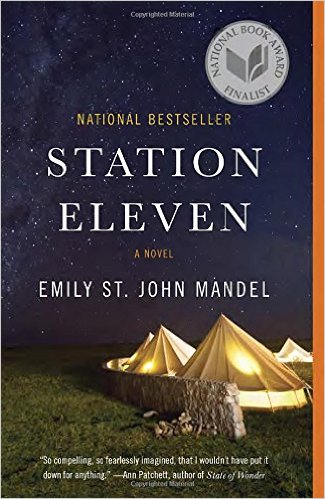
Station Eleven

Here’s how it works.  An alarming new flu virus crops up half way across the planet in the Republic of Georgia with a frighteningly short incubation period.  Within hours of exposure you will be sick.  Within a day or two you will be dead.  It is traveling fast – very fast - and it is headed in your direction.  Within weeks the civilization you know will have evaporated and if you have somehow survived, you will question whether you were one of the lucky ones.
I’ve not been drawn to doomsday literature nor dystopian-themed books or movies.  Although I know many are considered to be nothing short of masterpieces (1984, Fahrenheit 451, Brave New World to name a few - none of which I have read), my exposure to that genre has been limited, nearly non-existent.  Station Eleven by Emily St. John Mandel may be my breakthrough book.  Mine eyes are open.
Although the writing is good it is the story itself that kept me reading far too late into the early morning hours and against my better judgment.  It was what I thought about as I turned the key in the ignition of my car or casually turned on the lights, never before surprised or awed that they would work.  I stood in the produce section of the supermarket and stared at the beautiful colors, the freshness, the amazing array of choices.  So many things at our fingertips, just for the asking. Just for the buying, because we know currency will work and credit cards still exist.  You pick up a pepper, judge it against all the other peppers and put the best one in your cart.  And then you go home and hit the remote for the garage door opener.  You put the groceries in the refrigerator.  You fire up the grill.  You call someone - your mother, your sister, your child, your friend on the telephone.  Probably your cell phone.  You laugh together and close with “Love you,” or “Talk to you later.”  And you open a bottle of wine.  You watch a movie.  You read a book.  When you go to work, there will be people there.  Alive.  You are never alone if you do not wish to be.  It is life as you know it every day and you don’t dwell upon it much, if at all, or upon whether there will be a “later.”
What if it all vanished in a fortnight?  It is the “what ifs” that make this book so compelling.  Is a deadly pandemic so out of the question even in this age of modern medicine, science and technology?  What if one was so fleet and so lethal that there was no time to devise ways to fight it; or those who may have been successful in doing so have perished in its rising wake?  Just think about it:  “No more porch lights with moths fluttering on summer nights.  No more trains running under the surface of cities on the dazzling power of the electric third rail.  No more cities…No more flight.  No more towns glimpsed from the sky through airplane windows, points of glimmering light…No more pharmaceuticals.  No more certainty of surviving a scratch on one’s hand, a cut on a finger while chopping vegetables for dinner, a dog bite…No more fire departments, no more police.  No more road maintenance or garbage pickup…No more internet.  No more social media, no more scrolling through litanies of dreams and nervous hopes and photographs of lunches, cries for help and expressions of contentment…No more reading and commenting on the lives of others and in so doing, feeling slightly less alone in the room.  No more avatars.” 
Dystopia.  Not a good place.  It’s the opposite of Utopia, which is where I’d rather live. But, in terms of a gripping book, it’s just not as much fun.  After one writes about the sun shining, the birds singing, and people living in peace and harmony on a healthy planet where everyone is well fed and highly educated, there isn’t much more to do than sit around and eat grape clusters listening to poetry recitations.

            Station Eleven, for all its bleak foreboding, ends on a sweet ray of hope.  If nothing else, it may provoke you to ponder what you might otherwise take for granted…or compel you to pick up the phone and make that call, as you meant to do but never found the time.

Thursday, July 16, 2015

Go Set A Watchman


I think Scout was the victim of a cruel hoax without her ever figuring it out.  It was not Atticus Finch she found when she returned to Maycomb.  It was his evil twin brother, Skippy.  Perhaps in the next installment, we will discover her real father is being kept hostage in the cellar...with Bo Radley.  Can there be another mystery manuscript hidden away in a strong box that will redeem this mess?   There are few things in life that are nearly perfect, and they should not be subject to tampering.

If you believe in Atticus Finch as much as I do, clap as hard as you can.  We can bring him back.  (It worked for Tinkerbell).  In the meantime, don't even bother with this one...it saddens me to say it. Whatever was she thinking.

Fear not.   Atticus Finch lives between the covers of To Kill A Mockingbird.  He will live there forever.  And nothing can change that.  It is a sin to kill a mockingbird, my friends.

Friday, June 26, 2015

Jonathan Strange & Mr. Norrell

About ten years ago I belonged to one of those big "book clubs." You know the ones. They send you a brochure every month. You can choose the selection for that month, or order something else from the catalog by sending in the little card that accompanies the brochure.  If you don't send in the little card advising you do NOT want the selection of the month, it is automatically sent to you (and charged to your credit card.)  It is a very successful marketing model since it taps into the fact that so many of us are (a) procrastinators, (b) forgetful, or (c) so disorganized we will lose the little card and never find it before the deadline runs out.  That is how I originally came to own the hardbound version of Jonathan Strange & Mr. Norrell by Susanna Clarke.  I had never heard of it, wasn’t interested in it, and lifted it up to a bookshelf where its substantial girth took up considerable real estate.  I looked upon it as another unnecessary financial outlay and resolved to mend my disorganized, forgetful and procrastinating ways.  But then my eldest child came to visit.

He was an early reader, having taught himself (apparently, because I didn’t teach him) at the age of 3.  I used to joke I bought him books by the pound rather than by storyline.  The bigger and heftier the book, the happier my boy.  He saw Jonathan Strange on the shelf, had heard the buzz, and with my blessing took it with him when he left.  I never thought of it again.  Fast forward 9 years. 

There are times when I am absolutely driven to find and read a book.  I usually can’t remember what triggers the obsession.  In the case of Jonathan Strange I may have heard that BBC America was about to unleash a TV series based upon it.  But I’m a little vague on that as well.  In any event, I placed myself in the library queue.  I was first in line and I could have waited.  But when it wasn’t ready by the second day I simply couldn’t stand the suspense any longer.  I ordered the paperback version from Barnes & Noble, which promised to have it delivered within 3 business days – free shipping.  When a book weighs in at over 1000 pages, free shipping clinches the deal to my way of thinking.

I’ve been dragging this doorstop of a book around with me for 11 days.  To the car wash, to the car dealership, to the hair salon, to the bank, to the office.  Wherever and whenever I think I’ll have the slightest minute of downtime.  I’ve left it (reluctantly) behind when I know it would be inexcusably rude to pull it out to read (like at lunch with a friend), or just plain wrong (like church).  But I have to admit, it’s painful. 

I’ve been trying to take it slow; that’s not easy.  It is so completely absorbing I really have to force myself to put it down and step away from it.  I am a little over half-way finished and I’m already feeling a little panicked.  At this rate, it will all be over in another week.  And then what shall I read?  “Will anything ever be this good again?” I ask myself.  When I've read the last page and closed the back cover, I expect it will take a long time to find another book that I can live in.  Oh yes,yes, I know.  I hear you thinking, “Isn’t she being a bit dramatic.”  No.  I am not.  In fact, I will go further.  There are words that have been invented to describe a book like this.  They include “magnificent,” “inventive,” “unique,” “mesmerizing,” intelligent,” “eloquent,” “enchanting,” “meticulous.”  Dear me.  I am slobbering, aren’t I. 

I’ve been having a lot less luck with the TV series.  It airs on Saturday at 10:00 p.m.  I am an early riser who finds it difficult to stay up past 9:00 p.m.  A hopeless wimp to whom New Year’s Eve is the day when people call me at midnight, waking me from peaceful slumber wishing me to be happy and creating the opposite effect.  I made it through about 15 minutes of Episode 1, was completely zonked out before Episode 2 even started, but am determined to put up a fight when Episode 3 rolls around tomorrow.  Hot coffee, sharp objects, an ice bath.  Figuring out whether I get “BBC America On Demand” is another option.  Although the remote scares me.  Or there is always the option of ordering the first season on DVD when made available

How is it that a book of this length seems too short?  The fact that the writing style remains consistent and sharp throughout is in itself a marvel, but it is the imaginative building of the story line –episode by episode - that is truly remarkable.  The novel is peppered with footnotes – some several pages long – which one would think would be terribly distracting when, in fact, they add immeasurably to the back story.  One can say it is a literary alchemy of sorts which, since the book is about magic, is just as it should be.  

I must remember to ask my son if he ever read the book.  The one I wish I’d have hidden under the sofa rather than leave it exposed on the bookshelf to be purloined by a book usurper.  The one I should have grabbed back while growling, “Get your own copy.”  After all, there are limits to the sacrifices a mother must or should make for her children. 


This, my friends, is the book I wish I could have written and I can’t give it higher praise that that.

Wednesday, June 3, 2015

Ross Poldark: A Novel of Cornwall, 1783-1787

I will be the first to admit that when it comes to television I tend to live under a rock.  But books…now that’s another story altogether.  So where have I been since 1945 when Winston Graham penned Ross Poldark:  A Novel of Cornwall, 1783-1787?  Not yet born for some of those years, granted.  But what is my excuse for the decades that followed?  And even though I have never been a big fan of TV, the exception has always been the fabulous offerings of PBS, especially via BBC productions.  I learned that the books had been produced for television back in the 1970s, like Upstairs Downstairs.  It was a big hit.  And yet…crickets chirping.

So when I heard, in a very casual way, that there was a new series coming to PBS in a few weeks called Poldark based on a series of books that have been around for quite some time, I did a little internet surfing.  What I read did not particularly grab me:  Ross Poldark, a British Army officer returns to Cornwall after having fought for the Crown in the Revolutionary War only to find his fiancé betrothed to his cousin and his family estate in ruins.  “Oh.  A romance novel,” I yawned deflated.  Not exactly my cup of gin.  Like a cherry on the top, the cover of the newly released book was even less appealing.  I would not have been surprised to find Fabio on the cover.  But I have great faith in the BBC and PBS.  “So, where’s the trust?” I asked myself.  The old adage is true:  one really can’t judge a book by its cover.  Or its blurbs.

I found a site that offered a sampling.  I just love samples, don’t you?  Yes, I do find them hard to pass up.  Be it cheese cubes, tortilla chips, warm pralines, shrimp on a toothpick, it doesn’t seem to matter.  Thinking “just a nibble,” I began with the prologue (yum) and read through the first chapter of the first volume (of which there are apparently 12).  It was over all too soon.  And as is the purpose of all good samples, when the “taste” was over I wanted more.  I was hooked and thrown into the boat.

My plan was to run over to my favorite bookstore at lunch and grab a copy today. (oh joy)  But a quick phone call confirmed they did not have it in stock.  (oh groan)  But since the order for today had not gone out (I called as soon as they opened), I could possibly have it in my mitts by Friday. (oh joy).  Having thus assuaged my “bookie” conscience by buying from my independent bookstore first (because if they disappear I'll blame myself), I ordered the second volume, Demelza:  A Novel of Cornwall 1788-1790 from Barnes & Noble, which I should receive by Monday at a fairly nice savings and free shipping. 


If all goes as planned, when the series starts on Sunday, June 21, I’ll have consumed both volumes and be fully satiated, smugly able to sit back and judge the quality of the production, and fully anticipating the banquet of 10 more volumes to go!!  I’ll try not to burp.

Wednesday, May 13, 2015

The Buried Giant

So, you get a gift.  The giver is someone who can always surprise you with his unique style.  As you turn the object over in your hands you can clearly tell it is something that was finely crafted and is somehow both sturdy and delicately wrought.  But…”What is it?  What does it do?” you ask.  “Well, see, you turn this lever and twist it here and pop that open and hold it like this.”  “Oh.  Yes.  It’s lovely, beautiful even.  But…which is it…is it a can opener or is it a flashlight?”  There is a small pause before he replies, “Exactly!!”
So how shall I describe The Buried Giant by Kazuo Ishiguro?  Notwithstanding that it is populated with ogres, pixies and a dragon, I wouldn’t call it a fantasy like The Hobbit.  And although it is set in sixth or seventh century England, a time following the collapse of the Roman Empire when medieval Europe was experiencing economic and cultural decline – and there is talk of lingering hostility between the Britons and the Saxons following the bloody war years - it certainly is not historical fiction.  You may think that because Sir Gawain, the nephew of the now-dead but legendary King Arthur, enters the picture as an old and tottering knight on a mission of his own that the novel should be classified as a myth…or perhaps an allegory.  The only thing I can say about its genre with any certainty is this:  The Buried Giant is odd.
The main characters are Britons Axl and Beatrice, an elderly married couple who live in a warren cut into a hillside.  Their neighbors have taken away their only candle for fear they are too old to be trusted not to start a fire by some careless act of neglect.  Beatrice resents this and refuses to resign herself to living in the dark.  It is a time when the land is covered in a dense and unyielding mist that clouds everything, including memory and all thoughts of the past.  In a momentary break in her own fog, Beatrice suddenly remembers that Axl and she have a grown son living in another village which might be reached within a few days walk.  She convinces her husband that they should leave the place of darkness and go to find their son.  Despite their age and infirmity, and although they realize the journey will be dangerous, they set out to do just that.   But danger can come in many shapes and forms; it can come from without as well as from within.  Sometimes it comes with remembering the past.
The landscape of this novel is more than figuratively desolate and at times it is overwhelmingly atmospheric and as weighty as a Delta summer.  But there are also moments of comic relief, kindness, and devotion.  That Axl and Beatrice love each other is reinforced for the reader with astonishingly simple grace:  "Are you still there, Axl?"  "I'm still here, Princess."  
If, as I did, you loved The Remains Of The Day or Never Let Me Go and you expect this newest novel to be similar in some way to either, you should prepare yourself to be disappointed.  To approach this book with any such expectation is to do it an injustice; it is maddeningly unique.  To be honest, at times I asked myself, “What am I reading here…and why?”  If  Don Quixote married The Wizard of Oz and begot Morte d’Arthur, would The Buried Giant be a second cousin once removed?   The answer came back,  Ishiguro is, after all, Ishiguro.  .  Masterful writing rests within the hands of the masterful writer.  No surprise there.  Truthfully, I am currently unable to grab hold of what makes this book so mesmerizing.  Perhaps I lack the mental muscle to properly dissect it.  Not on the first go-round in any event.

I would be hard-pressed to rate this book with “stars.”  It is so multi-layered it demands re-reading to get to the core…the sweet nutmeat…the “aha” kernel.  Did I love it?  Did I like it?  My opinion should not matter.  My advice to those of you who are determined to press onward through the labyrinth (and I do recommend as much):  relinquish your preconceptions, open your imagination, and stay buckled in.  The roads are rough, bumpy and will chill a person.  You may get bitten by a memory - which can fester or leave a scar.  Or overcome by the past as it rushes towards you and makes you wobbly, dazed and uncertain.  You may get lost in the mist that clings to every branch and bog.  But if you make it through, you will know what I've been trying to tell you...and further explanation will not be required.

Wednesday, April 22, 2015

The Shadow Of The Wind


Bea says that the art of reading is slowly dying, that it’s an intimate ritual, that a book is a mirror that offers us only what we already carry inside us, that when we read, we do it with all our heart and mind, and great readers are becoming more scarce by the day – The Shadow of The Wind by Carlos Luis Zafon

            When was the last time you were completely and utterly lost in a book?  A time when you came to the end, closed the cover, and emerged glassy-eyed and waiting to regain your bearings, reluctant to return to the real world.  I think, perhaps, it happens more often in childhood than adulthood.  You remember those summer afternoons being transported to Oz or falling down the rabbit hole or being yanked back to earth from the Land of Mordor only because your mother is calling you to supper, don’t you.  You do if you loved to read as a child.  Every now and again, however, it can happen when you’re old enough to know that magic isn’t real, that it’s all in the flick of the wrist.  But every once in a while you’ll pick up a book, begin to read, and realize – notwithstanding all your years of living - that there are all kinds of magic in which to believe.

            It is the summer of 1945.  Daniel Sempere’s father, the owner of a shop that specializes in antiquarian books, wakes him just before dawn and tells him to get dressed.  “I want to show you something,” he says.  Daniel follows his father through the narrow, hazy lanes of Barcelona until they stop in front of a large door of carved wood, blackened by time and humidity – the entrance to what resembles a crumbling palace.  “Daniel,” his father cautions, “you mustn’t tell anyone what you’re about to see today.” The door is opened by a man whom his father greets with familiarity.  “Good morning, Isaac.  This is my son, Daniel.”   Inside Daniel is stunned by what he sees:  labyrinths of passageways and corridors and halls, crammed from floor to soaring ceiling with bookshelves full of books.  “Welcome to the Cemetery of Forgotten Books, Daniel,” his father winks.

            His father explains that they have entered a place of mystery.  That every book within the walls has a soul.  The soul of the person who wrote it and of those who read and lived with it and dreamed with it.  “Every time a book changes hands, every time someone runs his eyes down its pages, its spirit grows and strengthens.”   A book that is forgotten – whether it be from the closing of a bookstore, the disappearance of a library, or simply consigned to oblivion – those who know of and guard this sanctuary make certain it comes here to live, waiting for the day when it will reach a new reader’s hands.

 Daniel’s father explains that according to tradition, the first time someone visits the Cemetery of Forgotten Books, he (or she) must choose a book and adopt it, making sure that it will never disappear and that it will always stay alive.  “It is a very important promise.  For life.”  On this day it was to be Daniel’s turn.

            As he roamed through the galleries of that seemingly boundless universe, his eyes spotted the book that he knew he would chose – or which, more precisely, had chosen him.  The gold letters of the title gleamed from the light peeking in from the glass domed ceiling. 

The Shadow Of The Wind
Julian Carax

            Taking it home with him, Daniel not only gets lost in the book, he becomes curious about its author – whose works, he learns, are being systematically hunted down and destroyed by someone unknown.  In his passion to discover who and why, he begins to unravel an amazing story of mystery, murder, and near madness, with shadowy plots and subplots and with enough ghostly gothic film noir essence, nail biting thrills, dangers lurking with every creaking floorboard, and both the nobility of the human spirit and its evil twin to keep the pages turning furiously.  I promise you, it’s pure literary seduction to which you will gladly succumb.


Tuesday, February 24, 2015

Bel Canto

I do a fair amount of work-related driving.  This week even more so as I anticipated spending over two hours a day traveling to and from South Carolina.  Normally, the idea of getting into the car and driving around town without an audio book does not make me break out in a cold sweat.  But long-distance driving is quite another matter, so I figured it would be a very good time to "read" Bel Canto by Ann Patchett, which is something I've been meaning to do ever since I finished State of Wonder.

I am currently on disc 5 of 9, which brings me a little more than half-way through, and I like the story line quite a bit.  World famous opera soprano, Roxane Coss, is engaged to sing at the palatial home of the vice-president of an unnamed South American country following a dinner party to celebrate the birthday of the chairman of a large Japanese electronics company.  The party is attended by rollers and shakers of industry and politically powerful personages.  The president of the unidentified country is supposed to be in attendance as well; however, the party falls on the evening his favorite soap opera is scheduled to reach its denouement.  He sends his regrets at the last minute.  Meanwhile, a terrorist organization has composed a plot to break into the house at the height of the festivities and kidnap the president.  The break-in is successful, but for obvious reasons the kidnapping is a bust. The terrorists take everyone who is in attendance hostage instead.

That is about all of the plot line I'm going to reveal, except to say a lot of the book is character study and is very well written - at least as far as I have come in the book.  Let's tally this up so far:  Plot line:  Very good; Writing:  Excellent; Character development:  Insightful.  So why am I not loving this book?  Narration.  Narration, dear readers, can kill a good book quite dead.

Because the aforementioned gala event is attended by multi-national glitterati, there are a lot of foreign accents to be heard among the crowd.  That's okay when the reader is reading inside the reader's head.  The mind sort of fills in the blanks without much notice.  But in narration?  Well, let's say in this particular instance it goes something like this:

Russian guest (predicable low voice):  "OH-prra eez wary eemporrtahnt een my cowntry."
Spanish guest:  (higher voice) "Eees eet polithicul or-r-r museeecul? Joo cahn nevahrrrr thell."
Japanese guest (halting sotto voce):  Well, there's just no way to type it, but it reminds me of Ming the Merciless in the old Flash Gordon television series.

It's a shame, really, to subject an otherwise very worthwhile book to linguistic torture.  And it is only because it is very worthwhile that I will soldier on until the end.  My advice to actors who wish to pursue a career in the book-reading biz is to ditch the phony accents.  Because unless you're David Suchet or Meryl Streep, it seldom works and you will only accomplish ruining the experience for the poor reader who, like me, is trapped inside their car contending with foul weather, traffic jams and road construction.  Is it too much to ask that you simply read the words?

As the Russian said, shaking his head, "Eees so wary froostrrating."  I hear you, pal.  I feel the same way.


Monday, January 26, 2015

The Yellow-Lighted Bookshop

In my earliest memory of...well, anything, I am 3-1/2 years old and standing next to my mother in the dining room one early, gray winter morning.  We lived in a brownstone two-flat on Lawndale Avenue in Chicago which my parents bought after the war.  It was 1951 and the dining room was cozily heated by a wood-burning stove.  She was holding a brightly colored book-order form that my sister had carried home from school.  My sister made her selections, then my mother turned to me and said I could chose one book as well.  I still remember the thrill of excitement, looking at the pictures of the book covers.  I chose The Tall Book of Make-Believe illustrated by Garth Williams.  Over fifty years later, when I was forced to evacuate my home outside Savannah, a hurricane bearing down on us, the only possession I took with me was that book. That battered, bent, raggedy-paged book.  That book which traveled with me to college, and to Europe, and to Hawaii, and eventually to an island along Georgia's coast.  In a world of possessions, it was what I could not lose.  On that cold winter morning in 1951 I was not yet a reader; but it was the moment I became a book lover.  Over the intervening years I have read many fine books, great ones, masterpieces written by gifted authors.  And yet, The Tall Book of Make-Believe remains the most important and influential book I have ever held in my hands.  For those of you who have seen Citizen Kane, it is my "Rosebud."

When I was roughly 8 years old, my parents moved us from the city to the suburbs.  The library was 7 blocks away, an easy bike ride over what were still very urban streets.  It was housed in a corner store front building; the librarian sat at a heavy oak desk to the right of the front door.  I would head directly to "my section" which was located in the back, right-hand side of the room - second row from the end.  It was from this library that I borrowed my first chapter book, The Wizard of Oz.  It was bound in an appropriately green cover, sprinkled with small yellow fleur de lis.  I wish I could find one just like it.  And then, after carrying my stack of books quietly to the desk, the librarian would hand me a pencil so I could print my name on the little pocket card.  She would pound the date stamp on the pad and "plunk" it onto the return slip glued to the inside cover.  I would pedal home, books in the basket of my bike.

As Lewis Buzbee writes in The Yellow-Lighted Bookshop, his very readable book about books, printing them, selling them, lusting over them,  "[t]ake someone who likes to read; give her a comfy place to do so and ample time for doing it; add one good book, and then more; stand back."  As all book-lusters know to be true, we are "drawn to the bookstore by the books that moved us, and stopping for just a moment, we stayed for a long time."
A book, as Buzbee points out, "is a uniquely durable object, one that can be fully enjoyed without being damaged.  A book doesn't require fuel, food, or service; it isn't very messy and rarely makes noise.  A book can be read over and over, then passed on to friends, or resold at a garage sale.  A book will not crash or freeze and will still work when filled with sand.  Even if it falls into the bath, it can be dried out, ironed if necessary and then finished.  Should the spine of a book crack so badly the pages fall out, one simply has to gather them before the wind blows them away and wrap with a rubber band."

It is clear that Lewis Buzbee loves the physical book, the printed version, the real McCoy.  When first published in 2006, this little volume expressed his concern that ebooks and Internet booksellers might signal the end of the bookstore and the book-book.  However, as proof of the resiliency of the printed book he asks us to take a simple test:  "Look around on the streetcar or bus or airplane and count how many e-readers you see.  None.  We still prefer that quiet rustle of the pages, and besides, how do you press a wildflower into the pages of an e-book?"  Fast-forward to 2015, however, and it's easy to see things have changed.  Not everyone among the general readership desires the "quiet sensuality" of the printed book.  In his 2008 Afterword, he admits there's no doubt about it - it's a bad time to be a bookseller.

Yes, I loved this little volume.  What book-luster would not?  Who among us hasn't, on occasion, become a "book snoop," straining to make out what that person sitting across from you on the train is reading?  Loving how the unique smell of the bookstore wafts over you as soon as you enter.  Being alone among others?  Who hasn't stopped in a bookstore for "just a moment" and stayed a long time? I have no idea whether the bookstore or the printed book will survive as technology presses on.  Or whether a young reader in the next millennium will find the same satisfaction in flipping electronic pages as I did reading under the covers with a flashlight, or peddling home, basket heavy with Nancy Drew or Heidi or that silly Mrs. Goose And Her Friends.  Or printing my name on the flyleaf.  This book belongs to ME.

But one thing will always be true:  When one opens the covers of a book, the universe unfurls itself.

Friday, January 16, 2015

Rhapsody In Blue(s)


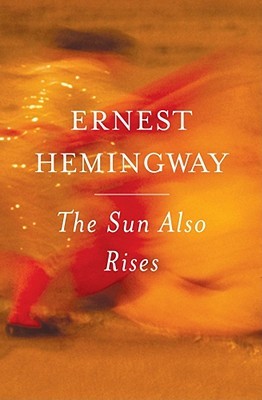
My latest book order came!  I had not realized I color coded my choices.  Was it a trend?  Had I been doing this subconsciously for a while?  Impossible!  Preposterous!  So, I checked.  The month before I walked out of the bookstore with The Crystal Cave and The Sun Also Rises tucked under an arm.

The Sun Also Rises
The Crystal Cave (Arthurian Saga, #1)

and then there was the book order comprised of:

In the Heart of the Sea: The Tragedy of the Whaleship Essex


In the Kingdom of Ice: The Grand and Terrible Polar Voyage of the USS Jeannette


The proof, as they say, is in the cover art.  I have no idea how long this has been going on.  Is it a sign of something deeper, more psychological, than the lure of a color wheel?  Wouldn't it be fun to take all the books one owns and line them up by hue?  Just to see how it looked?  Discover your primary palette for prose!  Define your literary pigment.  Achieve the ultimate crayolafication of your reading life!  Are you a tranquil blue, a dignified gray, a tender pink?  Or perhaps you are:

The Camerons

Plaid?


Tuesday, December 30, 2014

And The Winner Is...

Whoosh.  Did you feel that?  Another year zooms on down the road leaving some of us wondering what the heck just happened.  Am I richer?  Thinner?  Fitter?  Or perhaps a combination of thinner and fitter which I will call "thitter."  Do I see a more peaceful world?  A cleaner one?  Have I been kinder, or have I at least tried?  I suppose it's inevitable that at the close of each year one can't resist the urge to take inventory and tally up the balance sheets of life.  I don't particularly like the exercise and generally avoid it...with one exception!  The books I've read.

All The Light We Cannot See by Anthony Doerr, is not only the best book of fiction I read in 2014, it is the best book I've read this year.  No, that's too limited.  It is the best book I've read in many years. I would not be surprised if I learn someone plans to make a "major motion picture" based on it.  Just, please, whoever you are...please do it justice.

Last October I had a bunch of coupons for Barnes and Noble for 20% off that were set to expire.  Since I also have a membership, I get an additional discount plus free shipping when I order books on-line.  The rationale I use is thus:  with a coupon and extra discounts, one is not spending money one is saving money.  Using this rationale, I had a great time saving tons of money by clicking, and entering coupon codes, and applying discounts.  When the books began arriving it was actually better than Christmas surprises.  You might know that feeling:  "Oh, I forgot I ordered that.  How wonderful."

One of those books turned out to be the best book of non-fiction I read in 2014.  In The Heart Of The Sea by Nathaniel Philbrick is based on the 1820 voyage of the whaling ship Essex out of Nantucket, which was rammed by a sperm whale (apparently in a deliberate attack...an event unheard of at the time) and sunk near the Equator in the South Pacific Ocean.  Twenty survivors packed into three small boats with little food, water or navigational equipment.  Only a handful made it home.  I was half-way through the book when I noticed for the first time that it was not only a New York Times Bestseller (something I don't follow) but the cover also announced that it is "soon to be a Major Motion Picture."  After a little checking, I see it is due to be released in a few months.   As a side-bar, if you didn't already know that the whaling industry had terrible consequences for the survival of the species, that and other acts of environmental malfeasance will probably make you sad and angry. Nevertheless, this is a whopping good story.

I read several excellent mysteries this year.  I especially loved The Tiger In The Smoke, an oldie by Margery Allingham, which had me turning pages like crazy.  It was all you hope a murder mystery will be. But, I'll have to give the award to The Dead In Their Vaulted Arches by Alan Bradley.  Not gripping, not spine-tingling, but well-written and my sentimental favorite since I find Flavia de Luce to be the most refreshing and precocious chemist/sleuth of all time.  Besides, this is the volume in which her long-lost mother, Harriet, comes home.  I had heard it was supposedly the last, but I'm delighted that number 7 will be out next week.  Have I pre-ordered As Chimney Sweepers Come To Dust?  You bet.

Although it was not published in 2014, I only got around to reading Bring Up The Bodies by Hilary Mantel this year and it gets the award for best historical fiction.  My only criticism of it was I wish it had been longer.  I wasn't prepared to reach the end.  It was that good.

Things That Matter by Charles Krauthammer is a collection of essays and articles written in his brilliant, witty, and insightful style.  Known mainly for his political commentary, Krauthammer is also a psychiatrist which I think gives him a special gravitas in his analysis of people and why they do the things they do.  There is some politics, but he writes so well on a number of subjects:  baseball, dogs, speed chess.  Even if you do not agree with him ideologically, I will bet you will like the guy after reading this book.

I can't remember how I learned about I Am Pilgrim by Terry Hayes. The cover art is awful, so I know it isn't what grabbed me.  I'm happy something did.  The story line, the tight writing, the contemporary subject matter all worked together to create a real edge-of-your-seat thriller.  I was going to loan it to a friend, but am too afraid it won't come back to me.  I don't want to part with it.  I can see a movie on the horizon for this one and would bet money someone has already bought the rights.

The most delightfully fun read was Where'd You Go, Bernadette, by Maria Semple.  I wanted fearlessly quirky, highly intelligent, but somewhat blundering Bernadette Fox to be my friend.  This was an audio book for me and the narrator's voice was perfect.  The wrong voice will ruin it every time.

I read one YA book this year (something I rarely do) but had heard so much about The Night Gardener by Jonathan Auxier that I figured, "Why not?"  Now that I've read it, if I was twelve or thirteen again, I would check under the bed every night and sleep with the light on, and dead leaves blowing about the house would make me run in a panic.

There were so many good books this year, I hate to pick favorites.  But these really did stand out and I can recommend each and every one of them.

So bring on 2015.  I can hardly wait.

Monday, November 24, 2014

Go Ahead: Challenge Me

The end of the year is breathing down my neck and I find myself glancing over my shoulder at the wreckage of broken resolutions, failed goals and challenges that remain unchallenged.  But I remain hopeful and ready to begin afresh.  Yes, Scarlett O'Hara, you are correct.  There's always tomorrow - or next year (at least one hopes). In six weeks I'll start again to think about painting the hallway, scraping the ceilings, planting a vegetable garden, and getting up an hour before dawn to exercise.  What I will not do is burden myself with a reading challenge on Goodreads.  Or rather, I will not make a blood oath with myself to read a book or two a week.  I will admit the Goodreads challenge is fulfilling in the same sort of way my 401k statement is fulfilling.  As I finish a book and hang a few stars on it, it gets saved in my little "Books Read" bank account.  And as the year wanes, a bibliophile takes pleasure in looking back over the year via the book covers that get lined up.  Or realizing that book was read last year, not this year.  Last year? I could have sworn I read it this year.  Or even more stunning when it happens to me..."I read that book?  I wonder what it was about?"

So, let's say you've set yourself a goal of 52 books in the year.  That's a book a week.  That's doable - especially if you listen to an audio book while driving or during that pre-dawn jogging you mean to accomplish.  Ah...But are we talking about reading The Haunting Of Hill House by Shirley Jackson or Natchez Burning by Greg Iles?  One could read the Jackson book four times before finishing the Iles.  Or perhaps three Penelope Fitzgerald novels and The Stranger by Albert Camus.  Do I really want to pick up George Eliot's Middlemarch when, at 900 pages, Goodreads will gently remind me that I'm "6 books behind schedule," which may therefore compel me to reach for a graphic novel - just to catch up rather than because I want to read it - all because being behind schedule is anathema to me?  Being behind?  Not making the grade? What - shall I lose the challenge just because I choose to cart around a tome?  It isn't that I don't want to read Camus.  I love Camus; Camus is brief and he is brilliant.  But I also love Victor Hugo and might want to re-read Les Miserables.  

Challenges are fine; they can be invigorating and self-affirming.  And they have their place.  I'm just not sold that a book challenge based solely on numbers is the right place for me to be.  I suppose you can argue that such a challenge encourages people to read more.  But let's face it.  A person who signs up for a reading challenge is probably already someone who reads without any prompting.  Goodreads is, after all, a place for readers.

I will still sign up for the 2015 Challenge when the time comes, but I'll challenge myself to something stress free - 12 books for the year perhaps.  I can still look at my "books read" bank and feel a smug satisfaction with myself as the covers start to add up.

Before the end of the year I would like to finish my little TBR pile which consists of The Sun Also Rises, Ernest Hemingway, Frankenstein, Mary Shelley, and Mr. Midshipman Hornblower by C.S. Forester.  I will most certainly finish the very delightful audio book Where'd You Go Bernadette, by Maria Semple but gave up on Among Others by Jo Walton narrated by...I can't remember.  The story was just fine but I could not take that voice for 8 more hours.  Just...could...not.

And, if I do not finish any of them, that will be okay too.  Because there's always tomorrow.  And as we all know, tomorrow is another day.

Saturday, October 18, 2014

Dewey's 24 Hour Read-a-Thon


Well, I am already into my stack which includes audio books so I can also run some errands.  This is the third time I have participated in the read-a-thon, which is a very good excuse to let dust settle, drink a great deal of coffee, and not answer the phone.  Hundreds of readers from all parts of the world are taking part in this unique event and I look forward to checking in with many of them and also to cheer them on.

Happy reading!

Sunday, September 21, 2014

Dearie

I was shopping for a dress.  A dress for my daughter's wedding.  In order to get there I had to pass the book store...honestly I did.  Really.  I decided I could not buy one...more...book.  I made a pact with myself.  Not one.  But...I mean, what's a person to do?  (Oh hush up.)  So, there I was...suddenly finding myself in the book store...and there was Dearie, a biography of Julia Child by Bob Spitz.  And on sale!  Yes, yes, I know.  I need to find the right shoes.  I need to find the right dress.  Sometimes, however, serendipity leads you to just the right book as well.  It's all good.

In the long ago past I was a young bride eager to use her Lenox wedding china.  I was married to a military man, and we lived very simply and frugally.  We made friends with an older couple.  They owned a Lincoln car dealership, had a beautiful home with an in-ground pool and sauna, and ate at very fine restaurants.  Intrepid as I was in my youth, I invited them to what was to be my second "important" dinner party.  (The first was Thanksgiving.  I made a turkey, invited my boss and his wife and the local parish priest.  The bird was lovely and golden brown.  I carried it sizzling to the table with great pride to the hoped for "ahhhs".  My (then) husband proceeded with the ceremonious carving and as he attempted to get through the neck stuffing, he asked, "Did you stuff this with cheese?"  I looked on horrified as he attempted to pull out a melted white strand that looked a lot like mozzerella and which eventually shot out of the bird, catapulted across the room and hit the wall with a loud splat.  It was, of course, the plastic bag containing the giblets.  "Um...gravy anyone?"  Never let them see you sweat.)

And so, for that second dinner party, I turned to Julia Child and my copy of Mastering The Art Of French Cooking, which I received as a wedding gift.  I made Homard Thermidor.  The two lobsters required for four people took up an entire week's food budget.   I mixed and dribbled and sieved.  I worried and fretted.  It was delicious, although I did overcook the lobster.  We ended the meal with Soufffle au Chocolat.  I was dead exhausted by the time my guests left the house, but fell into bed that night with the comforting knowledge that Julia was to be my kitchen salvation.  If I followed her instructions, I could do it.  I did and I have.  Today, without even thinking about it, I brought home chicken breasts and made two exactly as she suggested I should...the way I have been doing them for decades without giving it much thought:  Supremes de Volaille a Blanc (only made without the blanc).  To her, eating was the art as much as the cooking.

My original copy of Mastering has long ago lost both its front and back covers.  Several pages have fallen out and have been lost, a few more are stuck haphazardly into the falling apart book.  Pages are splattered with DNA evidence of balsamic vinegar, clarified butter, and wine.  A few years ago, at a library big book sale, I found another copy for $1.  What a lovely bargain.  It belonged at one time to Darris Plumb, so says her bookplate.  And in the margins dwell her wonderful notations:  "Very good," and at Filets de Poisson Bercy aux Champignons she notes "Betty says this is good."    I didn't trust Betty until I made it myself.  Betty was spot on.

In the early morning of Christmas Eve I make Julia's boeuf a la bourguignonne.  I make it in my Le Cruset rip-off and put in the oven to warm for Christmas dinner.  I make it exactly as she instructs.  I read the recipe and listen to her as she guides me step by step.  No fudging, no winging it.  Elegant enough for that important occasion, and yet easy for the end of a season that has been filled with stress and excitement.  Thank you, Julia.

Naturally, Julia Child is known mostly for her TV shows.  She kept me company when my children were small.  When I was pregnant with my second child, I put my first child down for his nap at 12:00 noon.  It was also the same time The French Chef was aired on PBS.  When I was expecting my third child, I put my two children down for their naps at noon, and there was Julia again.  Like a "big sprig" companion.

Russell Morash, the original producer of her show on WGBH-TV, recalled her voice as being "a cross between Tallulah Bankhead and a slide whistle."  I think a statue should be erected to Mr. Morash.

Since I just brought the book home today I can't tell you much about it or whether I will enjoy it, but I can't imagine not doing so.  And, as another bit of serendipity the movie "Julie And Julia" is playing on television tonight.  My only criticism of which is that they spent time making the "Julie" part of the movie.  How cool would that movie have been if it had concentrated on Julia's life only.  She's the real story, after all.  Well, in reality it will be a love story.  As Paul Child wrote to her before their marriage, "I want to see you, touch you, kiss you, talk with you, eat with you...eat you maybe.  I have a Julie-need."  Whew!  Is it just me or does anyone else think it's getting hot in there?  When I finish Dearie I will tell you all about it.